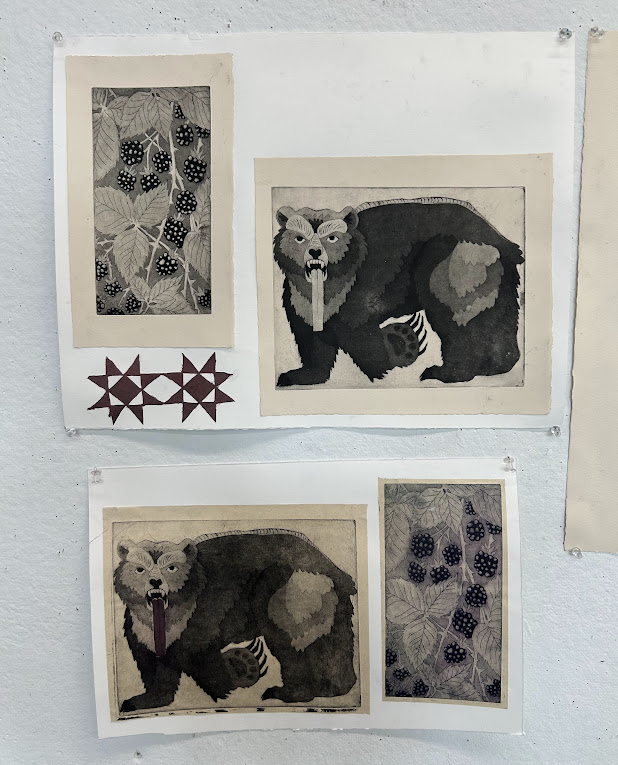
University Studio Art Teaching Practicum – Spring 2026
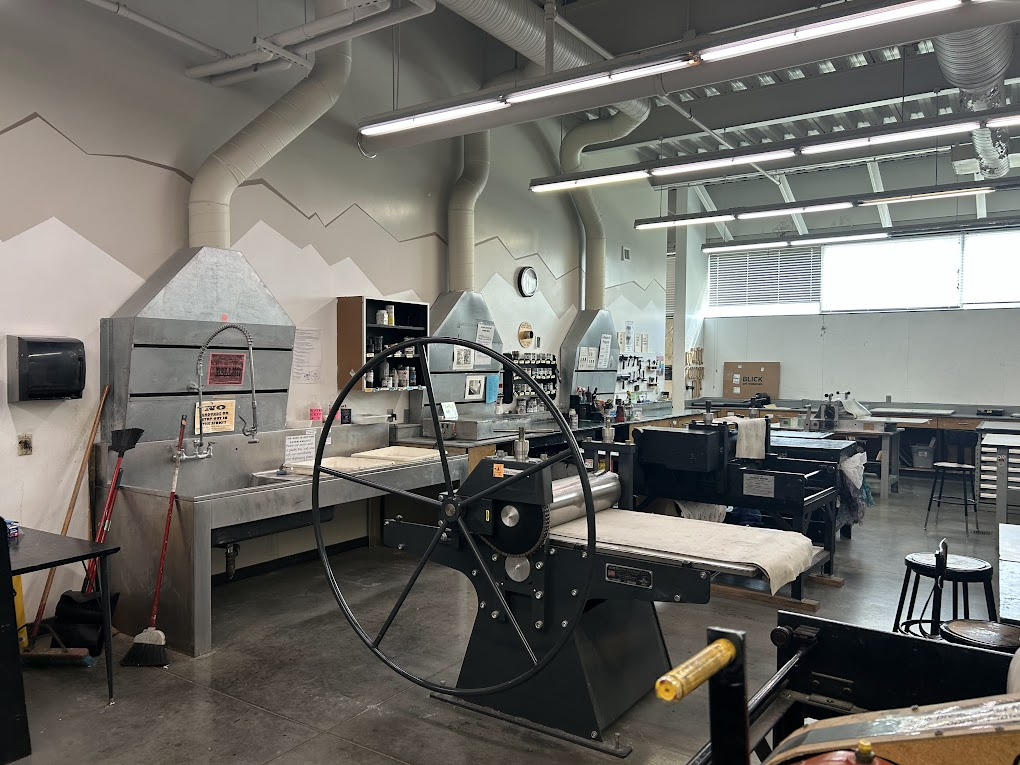
First day of class! – January 12th
This semester, I am shadowing Meredith’s Etching I class
Today was a short day, going over the syllabus for the class, as well as materials. She was straightforward and understanding with her expectations, and explained the rationale behind certain things.
Meredith brought a lot of prints for us to look at, showing what exactly etching is, and what you can do with the process.
Icebreaker – favorite video game or pets – I like a low stakes introduction
Job Search
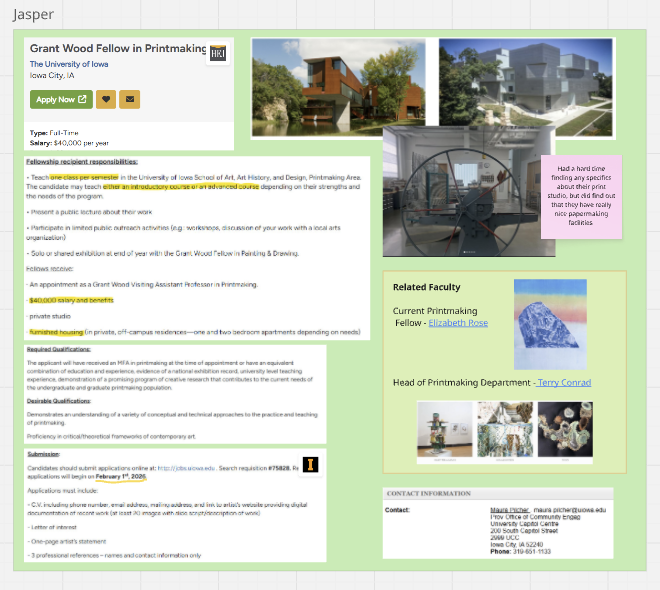
A few things I noticed while looking through jobs:
There aren’t a whole lot! Most are adjunct positions, or pools for adjunct positions.
This job has a lower salary, but does include housing which I found interesting – it is more like an artist residency than a permanent position. I also saw a lot of visiting professor positions – 1-2 year contracts, and most did not have the same requirement for 2-3 years of teaching experience that other full time positions did.
My Miro Job Search Board:
CVs
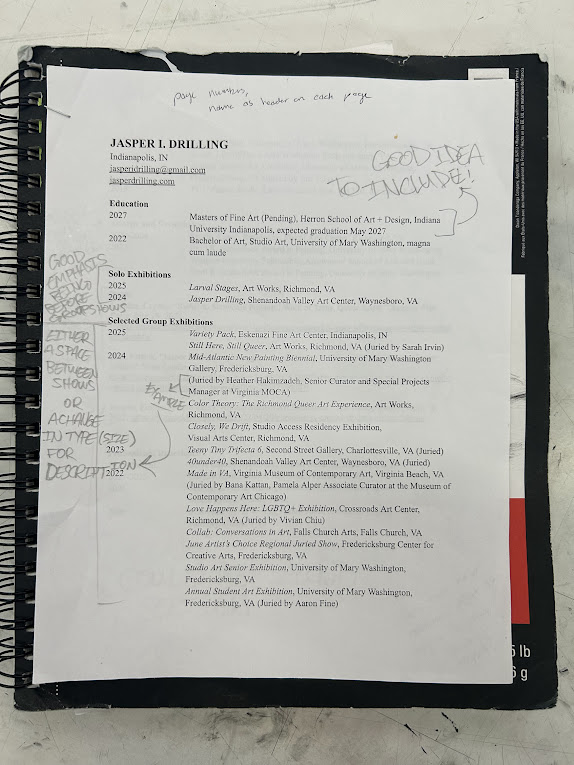
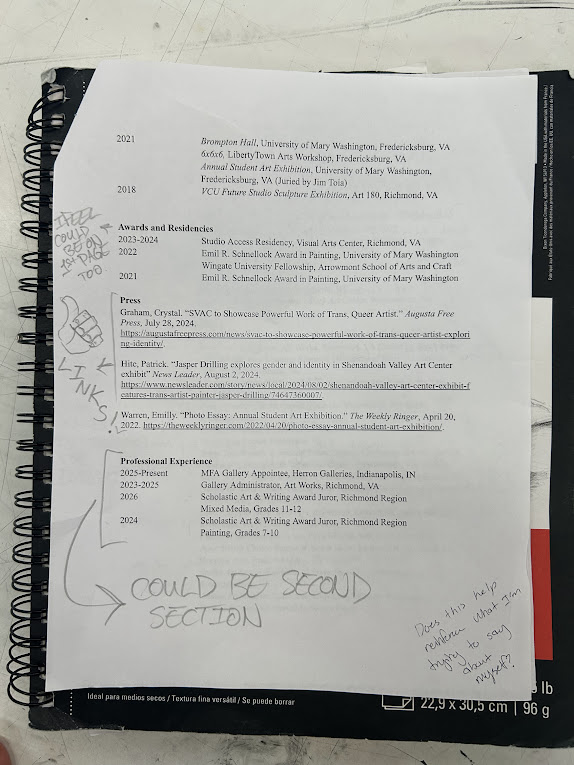
When looking at CVs, I was particularly paying attention to the categories that artists included, and order of the categories.
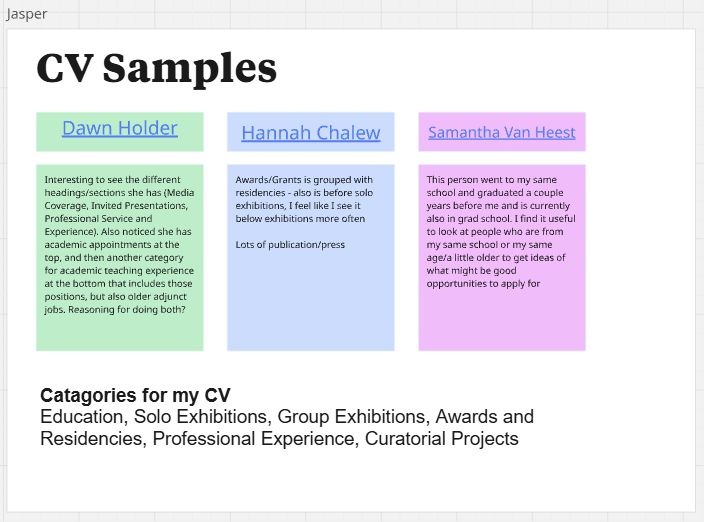
After looking through the CVs, I decided to add a Press category, and added the name of the Jurors to the juried shows I have been in. Right now, I have professional experience at the end of my CV, but I think if I were applying for a job I would put it as the second section.
Teaching Statement
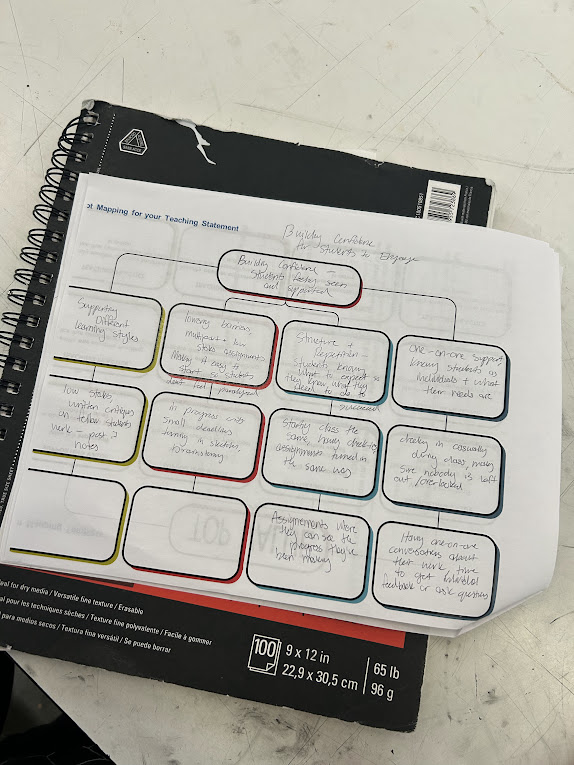
2/12 – Today we had a workshop on writing teaching statements, lead by Boyun Kim from the Center for Teaching and Learning. I found it very helpful – I had no prior knowledge about teaching statements, but the workshop made writing one seem a lot more manageable.
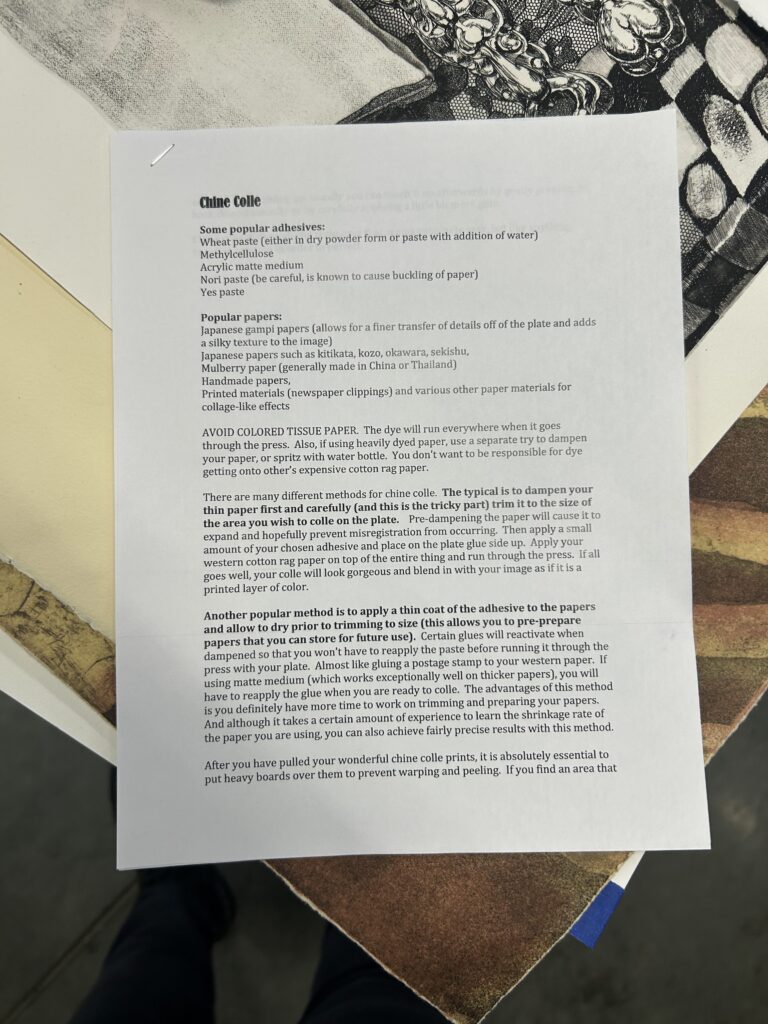
Chine Colle Demo – 3/23 Classroom Reflection
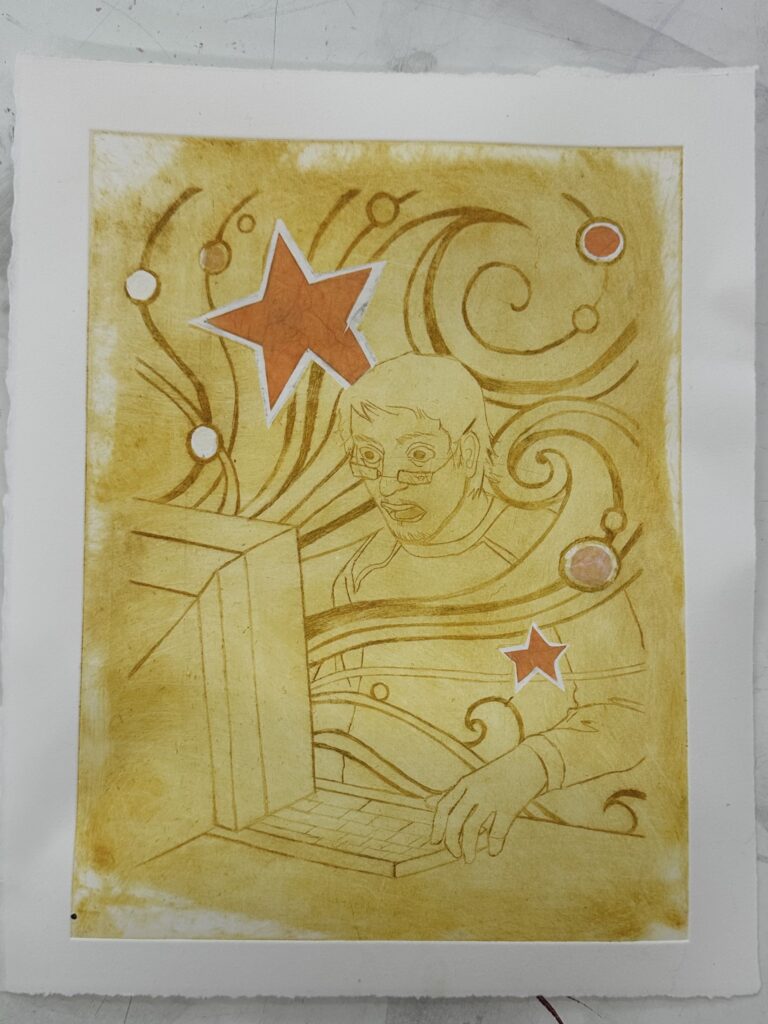
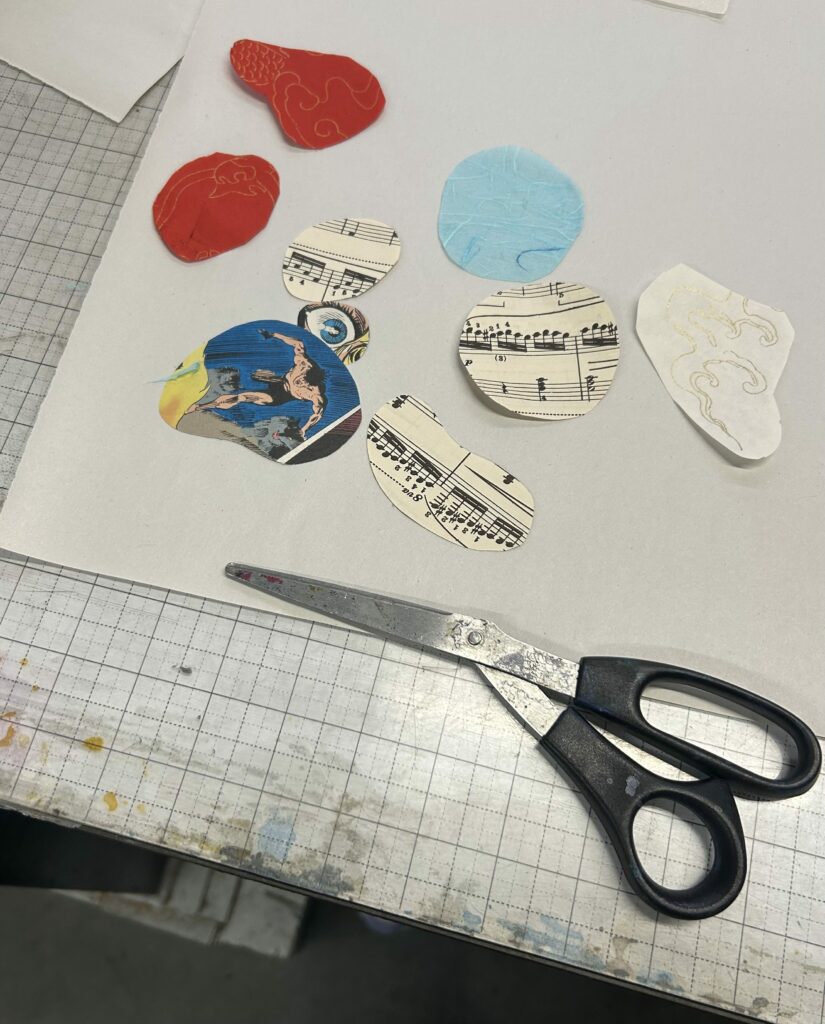
Today, we a demo on chine collé (a technique used to add different types of paper onto a print), and then the rest of class was a work day. I helped set up for the demo by cutting up pieces of paper, and then Meredith explained the process and showed the steps to do it. She gave an overview of the types of paper to use and not to use, the different ways to incorporate the process into prints, and the common things that can go wrong.
The rest of the class was a work day – some students tried chine colle, and others worked on different components of their project. I helped with the ones doing the chine colle, making sure they didn’t mix anything up (like putting the paper on upside down) and being there if they needed an extra set of hands. They all did it well and it was exciting to see how their prints came out!
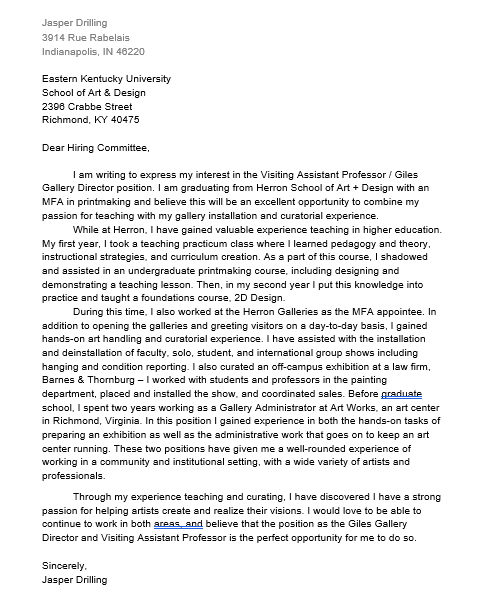
Sample Cover Letter
Hard ground and Soft ground Project Critique – 3/30 Classroom Reflection
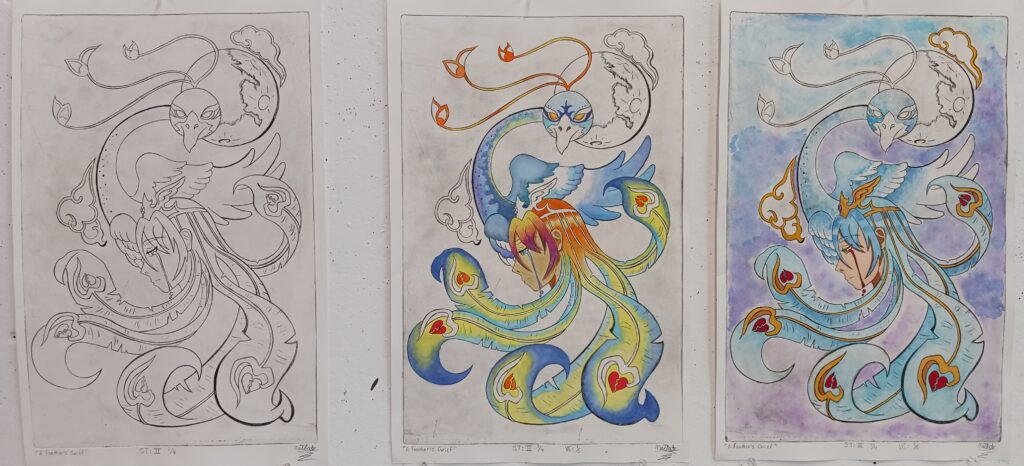
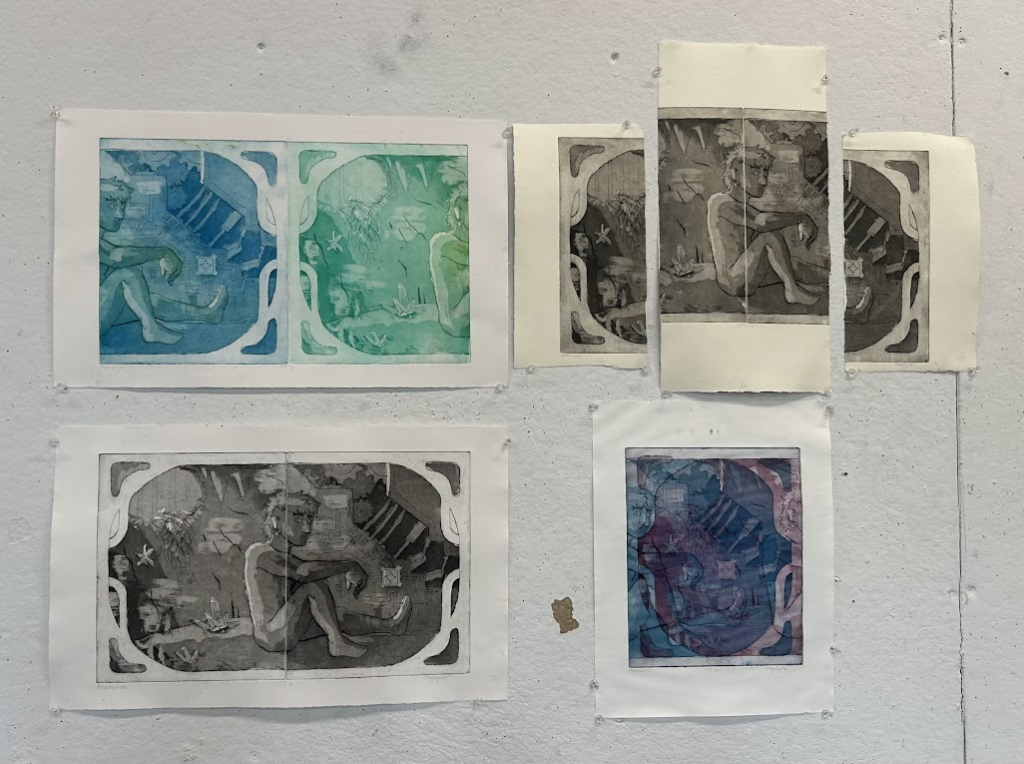
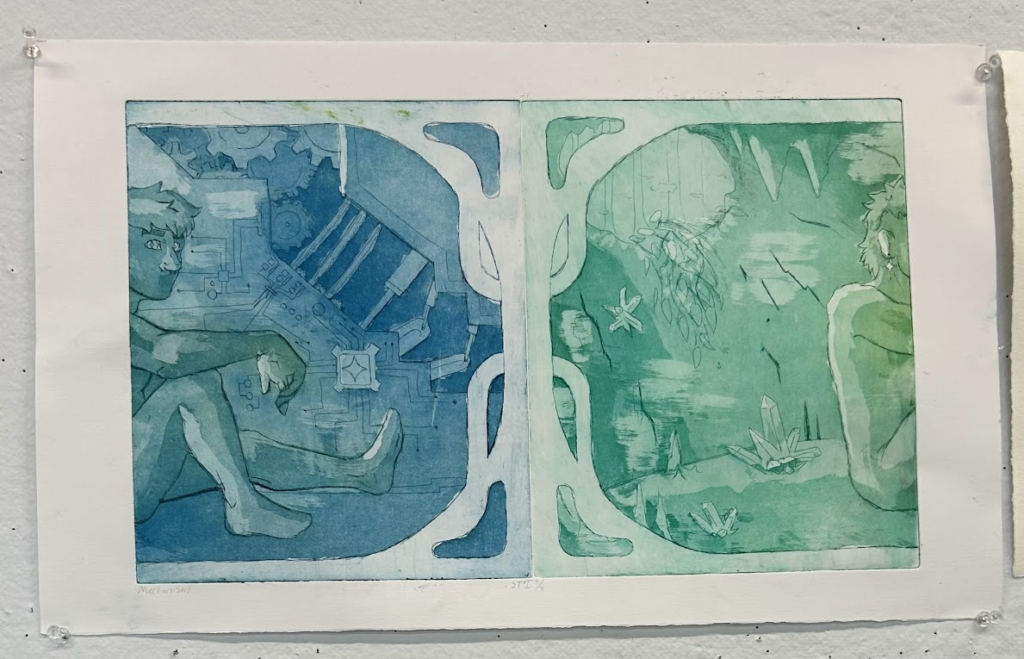
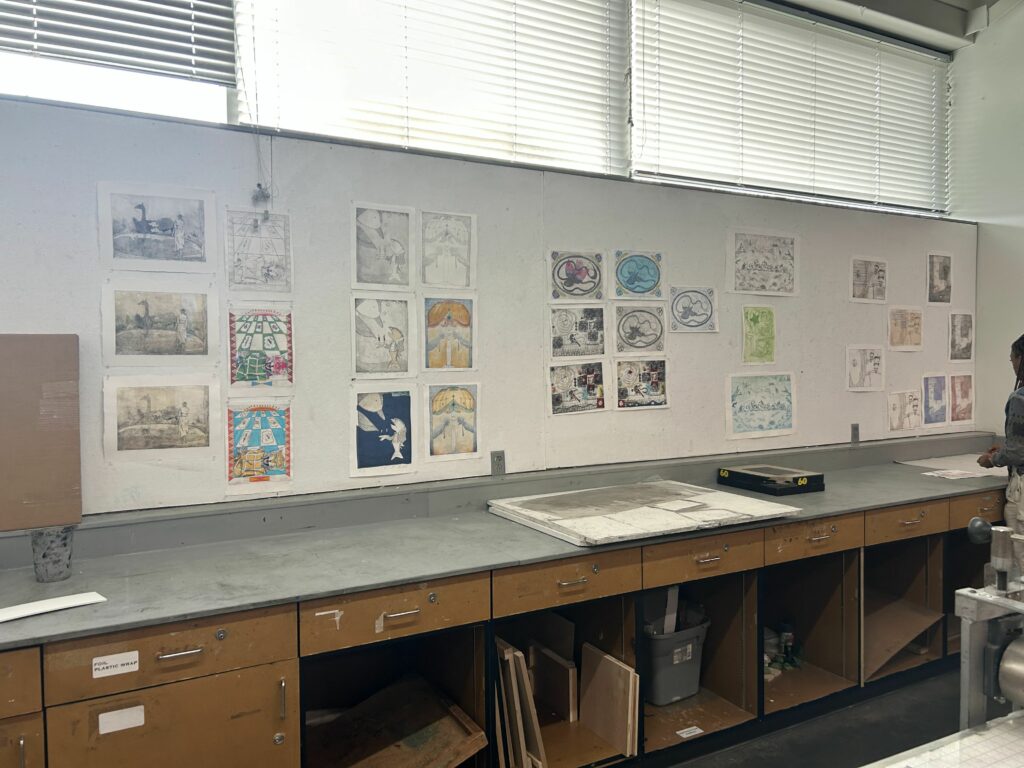
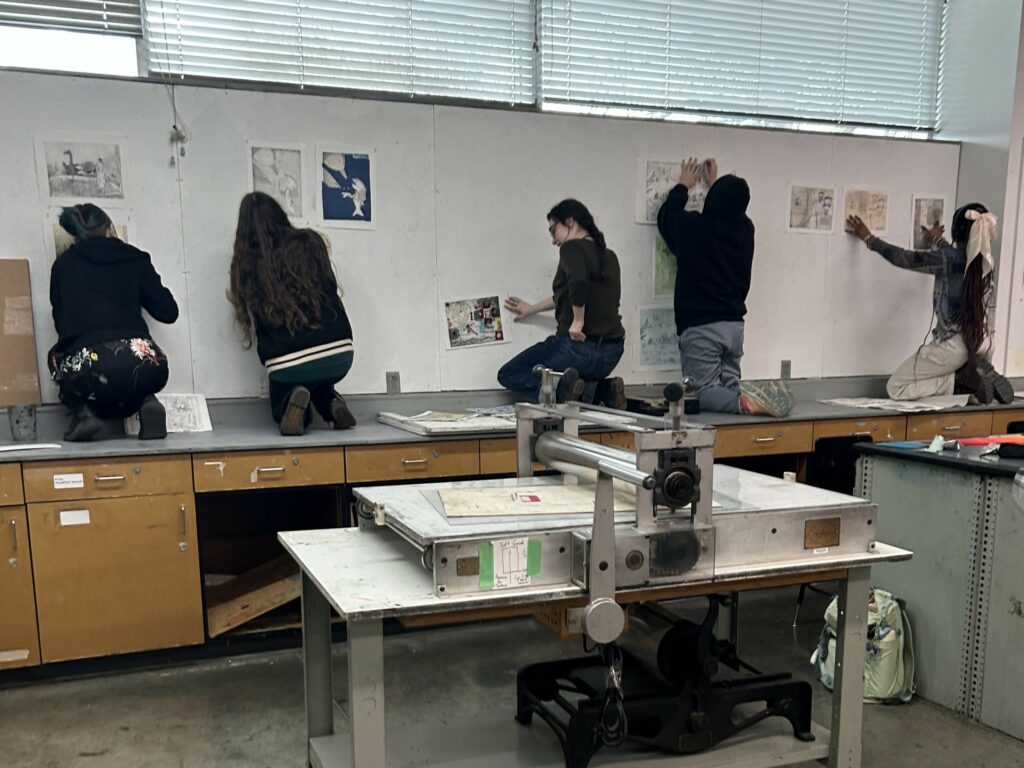
Today, we had a critique on the hardground and soft ground projects. The students had several versions of each, including two they had to add color to by hand, and two they had to add color using chine collé.
After everyone hung up their prints, Meredith had the students partner up with the person next to them and explain their pieces to each other for 5 minutes. Then the class came together, and they introduced their partner’s piece for the crit. I thought this was a successful approach because I have been in critiques before where people are very shy to introduce their work and unsure of what to say. This also gave a new perspective on the piece and gave students practice talking about work other than their own.
It was exciting getting to see everyone’s finished prints, especially since they were all so different from each other. Students were encouraged to bring whatever subject matter interested them to these projects. There was variety in subject matter but also the markmaking, coloring, and combination of techniques.
I made sure to comment on everyone’s pieces – it was interesting being in a critique in this kind of role, rather than a fellow classmate. I felt like I had to be more aware of my comments, making sure I was giving both positive and constructive feedback to everyone. The students next project is aquatint, where they will start by using one of these two plates to test the aquatint process and then move on to a new plate. I also tried to give feedback on areas where they might want to add aquatint, and use it to add more shading where it could use more contrast.
Micro Teaching Lesson Reflection – 4/6
Today, I did my micro teaching lesson on handmade papermaking stencils, and how it connects to printmaking techniques. I set up most of my supplies ahead of time, so that the focus could be on the specific technique that I was showing rather than papermaking as a whole because of the time frame. I prepared my pulp in two vats of water, one with color. I then met Meredith and the rest of the class in the etching room, and we walked down together to the papermaking area of the basement so that I could introduce them to the space – it seemed like people liked being able to go somewhere different and stretch their legs.
I started by passing around my printed lesson plan and asking who has ever made paper before (a few people had), and then introducing everyone to the space. I gave an overview of how paper is made and what the pulp is from, using the graphic I had printed on the back of my lesson plan as a visual guide. I already had pulp mixed with my water, but I grabbed a handful of the abaca pulp to show everyone, to make it clearer what it actually was. I tried to emphasize that although we have specialized equipment here at Herron, there are also easy ways to make paper at home without it.
Next, I described my stencil process, explaining how I made it, the different ways you can make stencils and layer them together, and how it is the same concept as printmaking with ink and commercial paper. As I did this, I showed some of my examples of previous paper I made and passed them around for everyone to look at. Then, I showed the actual paper pulling and stencil pulling. This part was very quick – I had done only a single layer pattern to try and make things clearer and more concise, but if I was doing this demo again, I think I would do at least a two-layer pattern to show more of the pulp printing process.
Then, I talked a little more about how you can use this technique in combination with etching, whether printing on handmade paper entirely, or collaging pieces with chine colle. I showed a piece that had etchings printed on it, as well as paper I had screenprinted on. Another change I would make in the future is to have examples of finished pieces of the actual stencil and pattern I was using in the demo.
To finish up, I opened it up to questions. Several people had questions, especially about how to make paper at home – for example how to make your own mould and deckle, and what type of paper to use to make recycled pulp.
Teaching Statement Draft
Teaching Statement Final
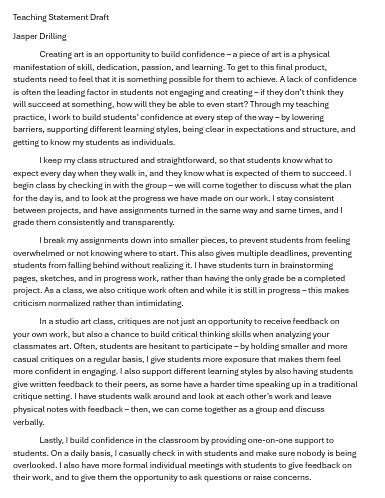
Creating art is an opportunity to build confidence. A lack of confidence is often the leading factor in students not engaging and creating – if they don’t think they will succeed at something, how will they be able to even start? Through my teaching practice, I work to instill confidence at every step of the making and learning process by lowering barriers, supporting different learning styles, being clear in expectations and structure, and getting to know my students as individuals.
Consistency in the classroom is the first step to creating an environment where students can develop confidence in their work and themselves. I keep my class structured and straightforward, so that students know what to expect every day when they walk in. begin class by checking in with the group – we will come together to discuss what the plan for the day is, and to look at the progress we have made on our work. Routine gives a sense of security in the classroom. As students experience enough anxiety in the world around them, I do not want them to feel caught off guard or uncertain. This transparency is consistent in my assignments and grading as well – by outlining exactly what I expect, students understand what is needed for them to succeed. Projects and homework are turned in the same way and same times, and I communicate how I will grade them ahead of time by rubrics and checklists.
I emphasize process as steps in learning, and I convey this to students by breaking down assignments into smaller pieces. This scaffolding prevents students from feeling overwhelmed or not knowing where to start. Especially early in the semester, I provide support in developing ideas for projects by making brainstorming pages and thumbnail sketches a graded assignment. I do not expect students to immediately come up with a fully formed piece of art with no support – in fact, I encourage them to spend more time on this preparatory work to fully develop their vision. By structuring assignments this way, there are also multiple deadlines which prevent students from falling behind without realizing it, and there is more frequent feedback and communication with students.
In a studio art class, critiques are not opportunities to receive feedback but also chances to build critical thinking and communication skills when analyzing others’ artwork. I structure critiques based on this focus on process and manageable steps. As a class, we critique work often and while it is still in process, rather than only a final, finished critique. Critiques become normalized rather than intimidating. Often, students are hesitant to participate – by holding smaller and more casual critiques on a regular basis, I give students more exposure that makes them feel more confident in engaging. Many students have a harder time speaking up in a traditional critique setting, whether because this is a new experience, they are naturally quiety or struggle with social anxiety, or auditory and verbal feedback doesn’t align with their learning style. To support these students – both to make sure their voices and opinions do not go unheard, and to make sure they are able to develop the skills and confidence to succeed in future critiques – I use scaffolding and alternative variations of the traditional critique structure. For most assignments, I have students walk around and look at each other’s work and leave physical notes with feedback – then, we can come together as a group and discuss verbally. Sometimes, I have students partner up to discuss their work, and then they will present each other’s work to the class during critique. This gives them a chance to practice speaking to a group, without worrying about their own work. These two approaches break up the experience into more manageable tasks and ensure that everyone participates.
Lastly, I build confidence in the classroom by providing one-on-one support to students. On a daily basis, I casually check in with students and make sure nobody is being overlooked. Sometimes this is me walking around the classroom to see who needs help, and sometimes this takes the form of more structured group check-ins. For example, if we are doing a critique where students are walking around the classroom and leaving notes on each other’s work, I will also set out a page where they can write how they are feeling about the assignment, what they are confused or need help with, or what they are excited or proud about. I also hold more formal individual meetings with students to give feedback on their work, and to give them the opportunity to ask questions or raise concerns. These frequent check-ins and one-on-one support help me to develop authentic relationships with the students, showing my empathy and care towards them. This relationship is a key component of students’ building confidence – knowing they have someone who believes in them makes it easier for them to believe in themselves.
In my creative research, I explore the symbiotic relationships that make up our environment and bodies, such as bacteria in our gut microbiome we need to break down certain foods, or the fungus and cyanobacteria that coexist in the form of lichen. Nothing in nature can exist without relationships and interdependencies, and the same is true in an academic setting. I do not expect my students to be able to succeed with no help. Instead, I create a classroom environment where we can build relationships and support each other through consistency and transparency, a focus on process through critique, and frequent individual check-ins. I structure the curriculum and manage the classroom by deliberately creating opportunities for students to develop confidence – confidence in me, the instructor, confidence in their peers, and most importantly, confidence in themselves.
Student Work Examples